FIELD NOTE · 2018
Naked Word, Part III: Feature Selection and Modeling
Naked Word: Nationalities of World Language
Part Three: Feature Selection and Modeling
Steps: 1. Get all the acquired numeric features
numerics = ['int16', 'int32', 'int64', 'float16', 'float32', 'float64']
df_numeric = df_0.select_dtypes(include=numerics)

print ', '.join(df_numeric.columns)
>> doc_id, unique_lemma, avg_stc_length, total_stc, POS_adjv_repeat_rate, POS_adjv_repeat_cnt, DT_max_dp_cnts_std, DT_ROOT_idx_mean, DT_pass_cnt_sum, DT_mark_cnt_sum

X = df_0[['unique_lemma', 'avg_stc_length', \
          'total_stc', 'POS_adjv_repeat_rate', \
          'POS_adjv_repeat_cnt', 'DT_max_dp_cnts_std', \
          'DT_ROOT_idx_mean', 'DT_pass_cnt_sum', 'DT_mark_cnt_sum']]
y = df_0['label']
X_train, X_test, y_train, y_test = train_test_split(X, y)
-
Fit all numeric features into a RandomForestClassifier to examine feature importance
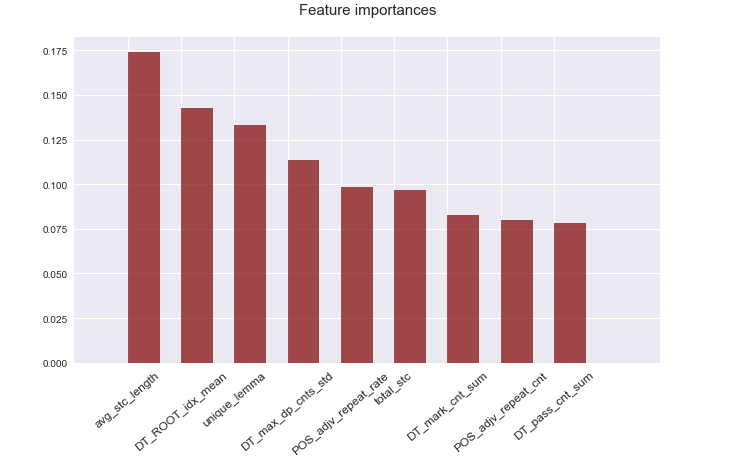 The order of feature importance (more to less):
avg_stc_length,DT_ROOT_idx_mean,unique_lemma,DT_max_dp_cnts_std,POS_adjv_repeat_rate,total_stc,POS_adjv_repeat_cnt,DT_mark_cnt_sum,DT_pass_cnt_sum -
Fit all numeric features into a GradientBoostingClassifier to examine feature importance for identifying a specific class. This is extremely useful for the Japanese and Korean native language groups because essays from these two classes appear to be mis-classfied as one another very frequently.
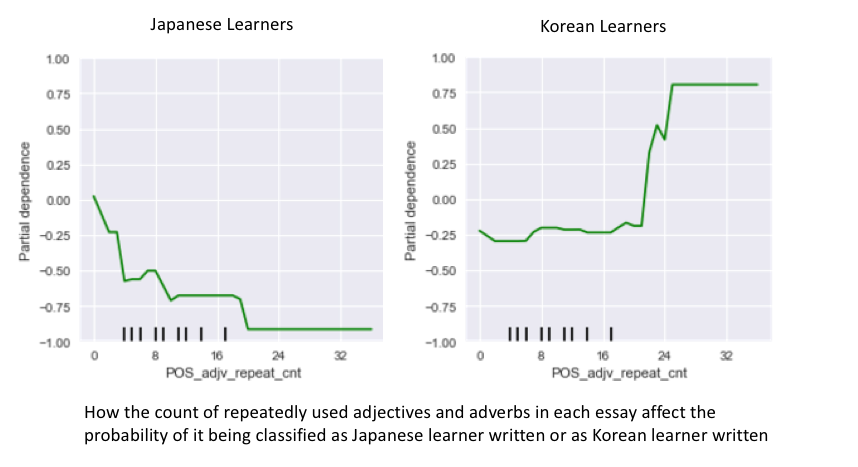 Significant features to differentiate 'JPN' from 'KOR' (more to less):
POS_adjv_repeat_cnt -
Evaluate how mere numeric features perform with different algorithms -
LogisticRegression: accuracy: 0.351129889756 -RandomForestClassifier: accuracy: 0.355977554772 -GradientBoostingClassifier: accuracy: 0.351245166152 Although better then random guess, modeling result shows that merely using these numeric features does not produce great result. Therefore, need to move onto more sophisticated syntactic features. -
Use tf-idf matrix on pos tag body for essays to train classifiers As mentioned in part one, I have converted the original essay text into the corresponding syntactic tags as listed below: DT_pos_join DT_archs_join DT_insent_pos_ngram DT_insent_arch_ngram
I have tried each of the four features separately, the result: DT_pos_join: accuracy: 0.664607324846 DT_archs_join: accuracy: 0.655624609373 DT_insent_pos_ngram accuracy: 0.65240657206 DT_insent_arch_ngram accuracy: 0.645502590324
- Try stacking two tf-idf matrices and train the classifier
X = df_0[['DT_pos_join','DT_insent_pos_ngram']]
y = df_0['label']
X_train, X_test, y_train, y_test = train_test_split(X, y, train_size=0.8)

vectorizer1 = TfidfVectorizer(lowercase=True, ngram_range=(3,3), max_features=800).fit(X_train['DT_pos_join'])
DT_pos_join_train_dtm = vectorizer.transform(X_train['DT_pos_join'])
DT_pos_join_test_dtm = vectorizer.transform(X_test['DT_pos_join'])

vectorizer2 = TfidfVectorizer(lowercase=True, ngram_range=(1,1), max_features=800).fit(X_train['DT_insent_pos_ngram'])
DT_insent_pos_ngram_train_dtm = vectorizer.transform(X_train['DT_insent_pos_ngram'])
DT_insent_pos_ngram_test_dtm = vectorizer.transform(X_test['DT_insent_pos_ngram'])

import scipy as sp
df_all_train = sp.sparse.hstack((DT_pos_join_train_dtm, DT_insent_pos_ngram_train_dtm),format='csr')
df_all_test = sp.sparse.hstack((DT_insent_pos_ngram_test_dtm, DT_insent_pos_ngram_test_dtm),format='csr')
df_all_columns=vectorizer1.get_feature_names() + vectorizer2.get_feature_names()

clf = LogisticRegression()
clf.fit(df_all_train, y_train)
y_pred = clf.predict(df_all_test)
The classification accuracy did not improve much.
- Use doc2vec vectors for essays to train classifiers
train_data, test_data = train_test_split(df_0, train_size=0.8)

col = 'essay_content'
train_docs = pwk.tag_docs(train_data, col, literal=True)
test_docs = pwk.tag_docs(test_data, col, literal=True)
model = pwk.train_doc2vec_model(train_docs, 2, 100)

y_train, X_train = pwk.vec_for_learning(model, train_docs)
y_test, X_test = pwk.vec_for_learning(model, test_docs)

logreg = LogisticRegression()
logreg.fit(X_train, y_train)
y_pred = logreg.predict(X_test)
So far, doc2vec matrix gives me the best accuracy: 0.815278